Tuesday, December 7, 2010

Willie Nelson


By 1982, the Outlaw Movement was long over and commercial radio-friendly pop music (e.g, the 1981 smash "9 to 5") had practically taken over the country music scene. In light of this trend, it made sense for legendary Memphis producer Chips Moman to record Willie singing a few well-chosen rock, soul, and pop selections from the 60s and 70s, though I doubt anyone could have predicted the immense popularity of Elvis's "Always On My Mind" as sung by Willie Nelson. As far as I know, it's his biggest hit as a performer.

Despite its obvious commercial appeal, Always On My Mind is not without aesthetic merits. Willie's voice was recorded perfectly and while the music isn't especially groundbreaking (The Flying Burrito Brothers recorded a country version of "Do Right Woman" back in 1968), the album cover has a post-modern quality to it that makes it stand out, despite its ubiquity. Whether intentional or not, the synthetic nature of Willie's chrome-colored outfit, his painted hair, and the collage of mountains in the background makes Willie look like some sort of futuristic hippie-cowboy in an alien landscape. At the same time, the look is his eyes is warm and inviting.

I mailed the Always On My Mind cover to Willie's ranch in Austin, Texas in January of this year and received it back yesterday, practically a year later. When I opened the package and examined the cover, I was surprised by the location of Willie's autograph, which is in the top right corner directly below the album title (pictured above). I've seen several signed copies of this record on eBay, but I haven't seen any signed in this particular spot. While one can never be 100% sure whether through-the-mail autographs are authentic, I do believe mine is real, despite the unusual signature placement. Otherwise, why would it have taken so long for the package to be returned to me? A secretary could have signed and returned this record 11 months ago. I also know that Willie has a reputation for being a very willing signer.

Below the album scan is a picture of a Willie Nelson autograph that I know is real. To my eyes, both autographs look like they were written with the same hand, though the first loop after the "W" on the album cover is higher than it is in the second photograph and in most other examples I have seen.

Wednesday, November 17, 2010

Charlie Louvin


I never thought I’d get to see Charlie Louvin play a dive bar in New York City, let alone have the experience on multiple occasions. The above picture was taken in 2006 at The Rodeo Bar in New York City and it gives you a sense of the intimate environment, as well as the configuration of his band. Charlie brought along with him a bass player and a female harmony singer/acoustic guitar player and the trio was rounded out by three local musicians: a mandolin player (partially obscured), drummer, and electric guitar player (not pictured). The New York backing band did an excellent job and, as you might gather from the look on the drummer’s face, the band played loud, energetic honkytonk music, not the watered down stuff you hear at Opryland.

My friends and I were in good spirits that night and were sitting at the front table, in plain view of the performers on stage. At the beginning of the show, I don’t think Charlie quite knew what to make of our group, but when he realized the extent to which we knew and loved his music, he warmed up to us pretty quickly, sitting at our table between sets and posing for pictures. At one point he even sang a song while seated at our table.

As I recall, Charlie’s setlist was a mix of Louvin Brothers tunes, hits from his solo career, and country standards. During the break I asked him if he would sing "I Don’t Believe You Met My Baby," which he reluctantly declined to play because he didn’t feel that his harmony singer would be able to hit the high notes that Ira hit on the old Louvin Brothers recording. The following year when I caught Charlie at Maxwell’s in Hoboken, NJ, I asked him if Ira, who died in 1965, could ever have imagined the environment Charlie found himself in now. He paused for a moment and said "I don’t think Ira could have handled it." I guess his answer didn’t surprise me, but I didn’t forget it, either.

It was at the Maxwell’s show that I asked Charlie to sign the above copy of his most popular solo record. I think you can tell by the illegibility of his signature that he was holding the record with one hand and signing it with the other, as there were no tables in the room for him to place the record while he signed it. Though this isn’t my most attractive cover, it does have sentimental value. I don’t know that I’ll ever have the opportunity to see a country music legend of Charlie’s stature in such a small club again.

I can’t end this post without mentioning that Charlie is recuperating from surgery he had this past summer for pancreatic cancer. The surgery did not go as expected, and he needs your prayers and support. Visit his website if you care to leave him a message.

Monday, November 8, 2010

Les Paul


Les Paul was 92 years old when I caught one of his regular Monday night gigs at the Iridium on March 17, 2008. It was on the list of things I wanted to do before I moved from New York City and I'm just glad I didn't wait any longer, as he died 17 months later. I guess my hesitation in seeing him was that I knew he would not be playing at the level he was playing ten or twenty years earlier. It wasn't until I saw him perform that I realized he could still put on a very entertaining show on the strength of his personality alone. Sure, he missed a few notes and he shared the spotlight with a few guest performers, but the banter between the musicians and with the audience gave me priceless insight into Paul's personality and a reasonable understanding of what his post-Mary Ford shows were like in earlier times, despite not hearing any blistering guitar dynamics. And, the fact that he came out after the show, sat down at a table, and shook hands and signed autographs made for an even more memorable evening.

As I stood in line to meet Les Paul after the show, I had three LPs and a brand new sharpie with me. When it came my turn to go up to Les's table, I handed him the records in the following order: least favorite cover, middle favorite cover, then my favorite cover. My thinking at the time was that the autograph on the third LP would probably look the best; after all, he'd have ample practice on the first two records. I couldn’t have been more wrong. The first autograph, on the World is Still Waiting for the Sunrise album I had inscribed to my friend John, came out beautifully with a cool personalization: "Howdy!" with the "P" in "Paul" making a pretty, round arc around the inscription. The second autograph on the mediocre Hits of Les and Mary cover came out okay, but the "Keep Rockin’!" personalization doesn’t fit with the music on the LP, which, like all of Les Paul’s music, simply isn’t rock and roll, and the "P" in "Paul" is much messier. The third autograph on my favorite cover, Lovers' Luau, came out the worst, with Les accidentally smudging his signature with his hand as he signed the cover.

It’s easy to second-guess the decisions I made when getting these records signed. Perhaps I should not have handed him the records in the order of least favorite to favorite, but I've had other experiences where I wished I had done this but hadn’t (see Gil Scott-Heron). Perhaps I should not have used a new sharpie, but I have autographs written with old sharpies that don't look very nice (see Pete Seeger). I suppose that if there's a lesson to be learned here, it's that much of autograph collecting is luck, not science. As I stated in the beginning of this entry, I'm just happy I got to see the legendary Les Paul at all.

Friday, October 22, 2010

Charley Pride


I sent this 1966 LP to Charley Pride’s post office box in Dallas earlier this year and got it back in the mail, signed, about a month later. The comment "my first album" leads me to believe he may not sign this one that often. This record features Charley’s first single, "Snakes Crawl at Night," as well as the great "Atlantic Coastal Line," both written by Mel Tillis and Fred Burch. I like the uncluttered, simple cover design, which is typical of late 60s RCA country LPs.

It’s worth noting that Charley’s early singles were distributed to country radio stations throughout the South without any pictures of Charley, for fear that racism might keep them from receiving airplay. At the time this LP came out, many folks assumed Charley Pride was white, and, consequently, this perfectly ordinary album cover likely surprised a few people.

Charley Pride still keeps a busy touring schedule, but he doesn’t play the Mid-Atlantic States very often. If he ever makes his way out here again, I’ll be sure to be in the audience.

Thursday, October 14, 2010

Hank Snow


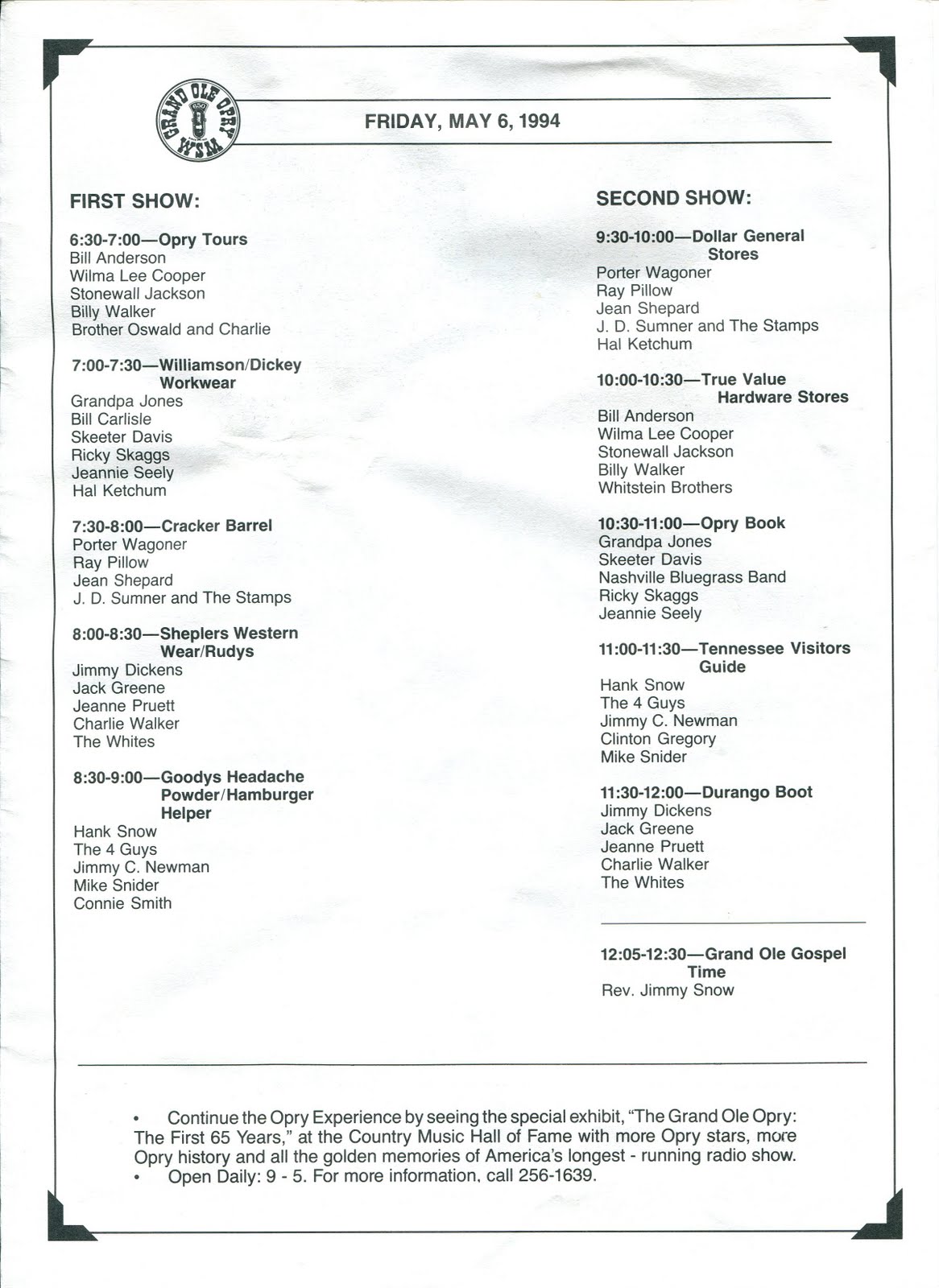
In May of 1994, some friends and I took a road-trip from Atlanta to Nashville, with the express purpose of meeting the venerable and relatively inaccessible country music legend, Hank Snow. Though Hank was still performing weekly on the Grand Ole Opry, he was not known for welcoming visitors. When we arrived in Nashville, we checked into a fleabag motel, hit a few used record stores, and then caught a Friday evening performance of the Grand Ole Opry, which was still regularly featuring Hank Snow in the final time-slot. Looking over the Opry program now, I see that Hank Snow, Porter Wagoner, Grandpa Jones, Skeeter Davis, Jean Shepard, Charlie Walker, Jimmy Dickens, and Connie Smith were all part of the same show. Not bad for an evening's entertainment, even if the Opry hasn't really been the Opry since it moved from the Ryman Auditorium in downtown Nashville to the suburbs of Opryland in 1974.

Hank's performance that night was rather unmemorable, as age had considerably slowed him down. I remember him playing a slow Hawaiian song and having some difficulty reading the cue cards for whatever announcements he was supposed to make. He was dressed impeccably in one of his trademark Nudie Suits and just seeing him on stage was enough to make the trip to Nashville worthwhile for me. The following day, my friends and I drove out to Hank's modest but well-guarded estate in Madison, and rang the buzzer at the foot of the gated driveway. A woman answered through the speaker and courteously but firmly told us that Hank was not (and would not be) available to meet us and sign our records. This unceremoniously ended our attempt to meet Mr. Snow, so I had to resort to eBay to acquire the signed Hank Snow record pictured above.

This Award Winners LP popped up on eBay earlier this year with a "Buy it Now" price of $6.00 and it is one of the few prominently signed Hank Snow albums I have seen on eBay -- most are signed on the back cover with a faded ballpoint pen. Interestingly, this record once belonged to United Shows of America carnival operator Ed Gregory, who owned the rights to Jim Reeves and Faron Young before he filed for bankruptcy in 2002. I can only guess that Hank signed it for Gregory while he was performing at a United Shows of America carnival. A decade or two later, Gregory and his wife were convicted of bank fraud in Alabama and soon to be (controversially) pardoned by President Clinton in 2000. A report by the U.S. House Committee on Government Reform concluded that United Shows paid Clinton's brother-in-law Rodham $240,000 for undocumented consulting services before Gregory received the pardon.

It seems very fitting that, out of all of Hank Snow's LPs, and he has over 100 of them, I would end up with a signed copy of this relatively obscure 1971 LP called Award Winners. Believe it or not, Award Winners was the only LP I was carrying under my arm that day in 1994 when I showed up at the Rainbow Ranch and tried to meet Hank Snow.

Friday, October 8, 2010

Red Simpson


During that same trip to Bakersfield where John and I saw Buck Owens at the Crystal Palace (see previous entry), we caught one of Red Simpson's regular Monday night gigs at Trout's in a town called Oildale, which is a few miles north of downtown Bakersfield. The 73 year old nightclub is the last remaining authentic honkytonk in the Bakersfield area.

Monday evenings are advertised as "SENIORS & SINGLES MIXER - LIVE MUSIC Featuring RED SIMPSON & LARRY PETREE!" and the music is really meant as accompaniment for dancing, the way it is at most of the best honkytonks in the country. On the warm September evening that we were there, the dance floor was packed, and most of folks dancing were over the age of 60.

Red and steel player Larry Petree played mostly country standards that night and surprisingly few truck driving songs, the style of country music Red is famous for singing. We had been in contact with Larry the previous week and he knew we were going to be in the audience that night. Shortly after we arrived, he introduced us to Red and Red asked me what song I wanted to hear, to which I responded "Roll, Truck, Roll," without thinking that there's not much room for Larry to play on that song--not that that really mattered. They played "Roll, Truck, Roll" early in the set and they played "Hello, I’m a Truck" shortly after and I don't remember them playing any other truck-driving songs. They mostly played music that was more suitable for dancing. This was definitely entertainment for locals, while Buck's show was geared more toward out-of-towners.

Red and Larry were very friendly with us and we all had a beer together after the show, where Red introduced us to his wife Joyce and signed our records. The entire place--the management, the wait staff, the bartender, the performers--were unusually welcoming and friendly, and this evening is my fondest memory of the Bakersfield trip.

Friday, October 1, 2010

Buck Owens


In September of 2003, my friend John and I took a weekend trip to Bakersfield to see Buck Owens at his Crystal Palace establishment. We weren’t able to meet Buck, but we were able to get a couple of LPs signed, thanks to our waitress who took our records backstage before the show started. Buck’s performance was decent, but I felt that he gave a little too much time to other (non-Buckaroo) members of his band, such as the backup singer pictured above. Even when Buck was in the spotlight, he wasn't exactly doing the things you expected to see him do. I distinctly recall him playing "Steel Guitar Rag" on the resonator guitar, which I would have gladly traded for a performance of "Streets of Bakersfield." In fact, the evening's entertainment was more akin to a variety show than a Buck Owens concert. Fortunately, I was able to catch a much more engaging Buck Owens performance at Bimbo’s 365 Club in San Francisco about a month later.

When John and I got our signed LPs back after the show, our waitress examined the signatures, confirming that Buck himself had, indeed, signed them. Earlier that evening, she had told us that other people sometimes sign for Buck, but that one could tell an authentic Buck Owens signature by examining the "B."